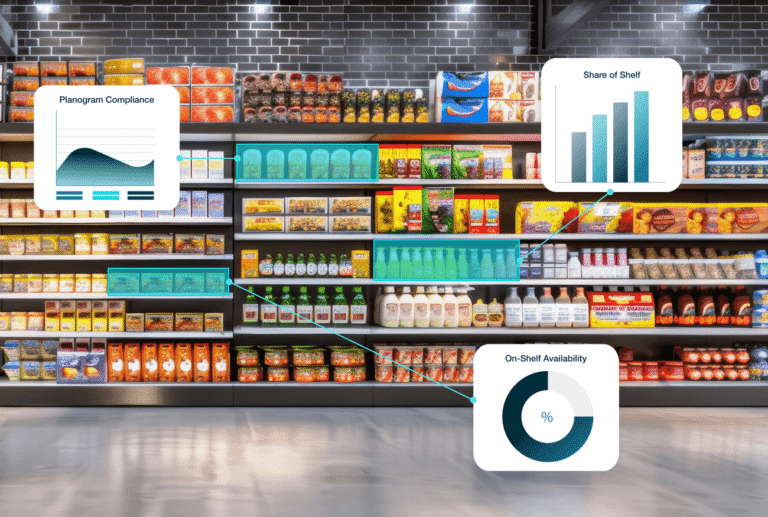


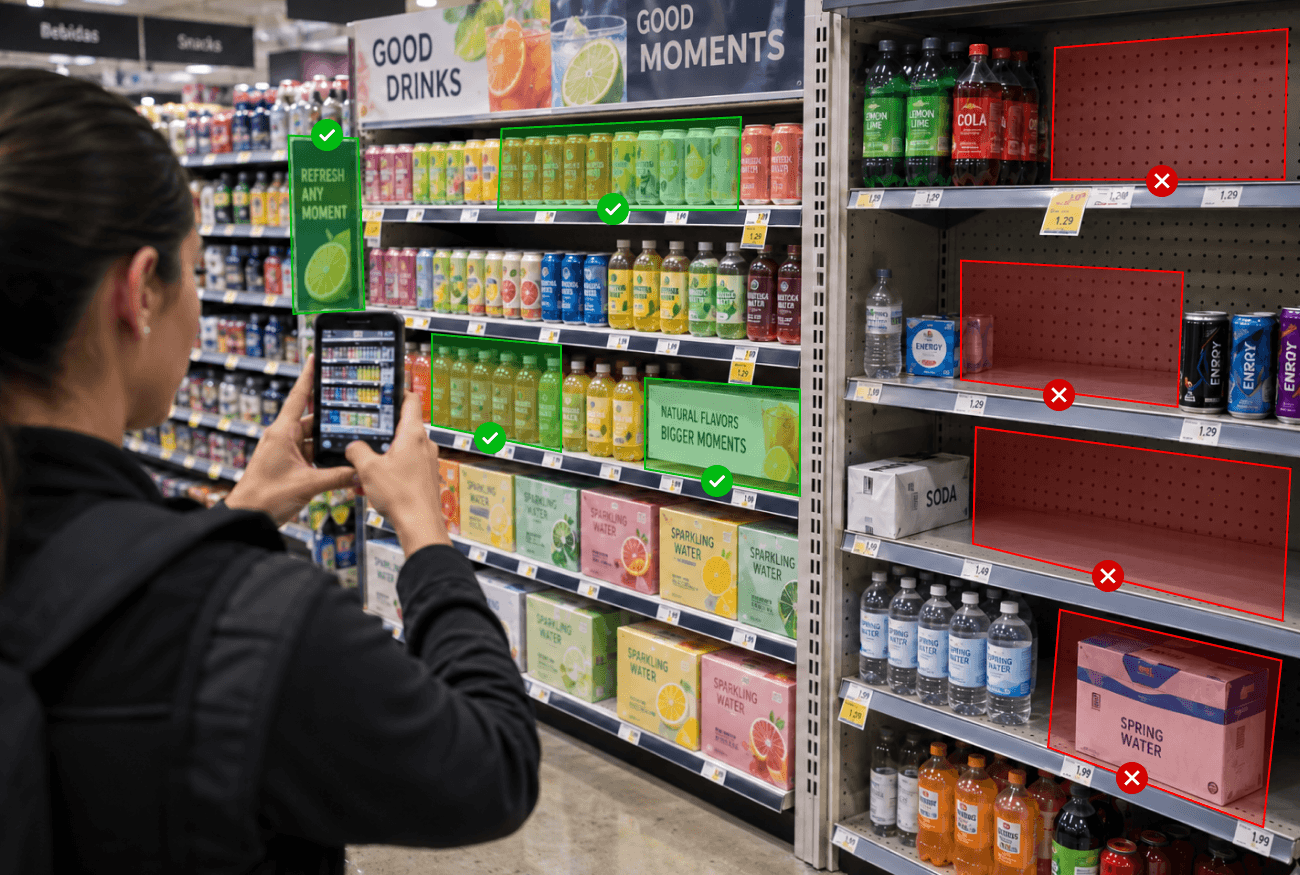
Your marketing budget is approved, your planograms are built, and your trade promotions are funded, but somewhere between headquarters and the shelf, execution breaks down.
For many Consumer Packaged Goods (CPG) brands, the reality in-store remains a blind spot. Manual audits, paper forms, and delayed reporting make it difficult to know whether products are available, displays are compliant, or promotions are being executed as planned. The result is wasted trade spend, missed sales, and lost growth opportunities.
The seven strategies below address the execution failures that quietly erode revenue and show how leading brands close the gap between strategy and shelf reality.
What Is Planogram Compliance Software—and Why Does Your CPG Sales Strategy Depend on It?
Planogram compliance software replaces paper forms, spreadsheets, and manual tracking with validated, photo-backed data from the physical store. Instead of relying on self-reported field audits, it gives your sales and marketing teams verified visibility into exactly how your products are placed, priced, and promoted at the shelf level.
Without it, your CPG sales strategy runs on assumptions:
- You assume displays went up on day one of the promotion
- You assume your pricing guidelines are being followed across every retail partner
- You assume out-of-stocks are being caught before shoppers walk away empty-handed
Planogram compliance software replaces those assumptions with evidence, and that shift from manual guesswork to data-driven execution is what makes every strategy below possible.
1. Master On-Shelf Availability and Combat Phantom Inventory
Out-of-stocks are expensive, but phantom inventory (where your system says a product is available but the shelf tells a different story) is worse. It creates invisible losses that never trigger a reorder signal, never prompt a field rep to investigate, and never show up in your sales data as a discrete line item.
For CPG brands managing consumer demand across hundreds of retail partners, this is one of the most significant and consistently underestimated drains on revenue growth. A shopper who reaches for your product and finds an empty shelf doesn’t wait—they reach for a competitor’s instead, and brand loyalty erodes one missed purchase at a time.
Closing the on-shelf availability gap requires real-time visibility that manual audits simply can’t provide:
- Instant gap detection that flags empty facings and missing SKUs at the shelf-level the moment a field rep walks the aisle, and not days later in a weekly report
- Automated restock triggers that turn a detected out-of-stock into an immediate corrective task, so reps can fix the problem before they leave the store
- Accurate inventory data that reflects real shelf conditions rather than system assumptions, giving your supply chain teams the ground truth they need to make informed decisions
For CPG teams serious about long-term growth, on-shelf availability isn’t a logistics metric, but a revenue one—and treating it that way starts with knowing what’s actually on your store shelves in real time.
2. Maximize Trade Spend ROI With Strict Display Compliance
Unbuilt displays, late setups, and incorrectly placed promotional materials are among the most common and costly failures in the CPG market. When a display goes up a week into a two-week promotion, or doesn’t go up at all, the marketing investment driving shopper traffic arrives at a shelf that isn’t ready to convert it. That’s both a missed opportunity and a direct financial loss on spend that’s already been committed.
Strict display compliance changes that with:
- Clear execution standards that ensure promotional displays are built correctly, placed in the right location, and activated on schedule
- Immediate visibility into display gaps and execution failures, allowing managers to address issues before promotional opportunities are lost
- Consistent accountability across retailers and field teams, creating a documented record of execution that supports performance reviews, retailer discussions, and future planning
For CPG brands spending millions on trade promotions, the difference between a display that executes correctly and one that doesn’t isn’t just compliance. It’s the difference between a campaign that delivers ROI and one that subsidizes a competitor’s sale.
3. Eliminate “Pencil Whipping” and Boost Rep Efficiency With AI
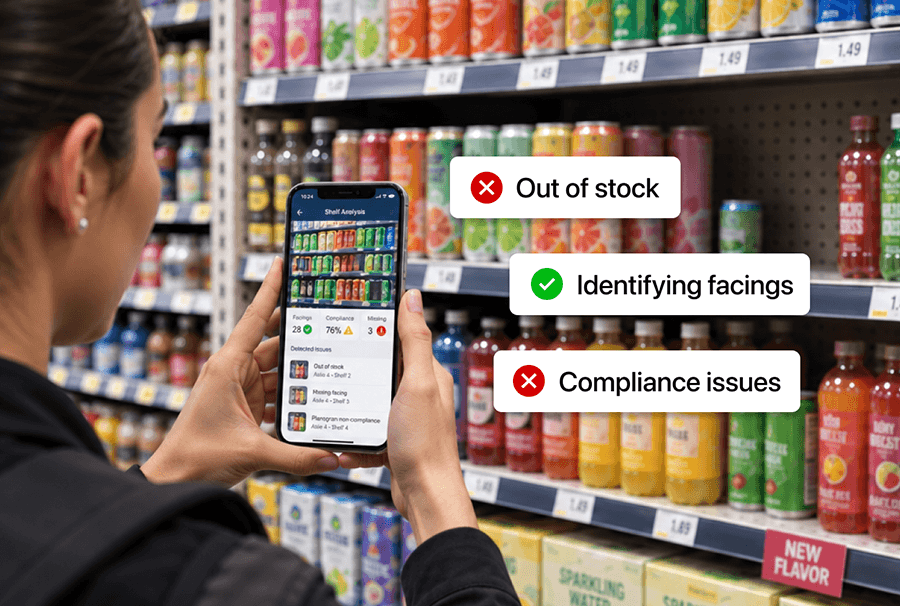
Manual auditing is one of the most persistent inefficiencies in CPG retail execution. Field reps covering fifteen stores in a day don’t always have time to count every facing, verify every price tag, and document every display—and when the pressure mounts, data quality suffers. The result is “pencil whipping”: forms marked complete that don’t reflect what’s actually on the shelf.
The problem isn’t your reps. It’s the process. Manual data collection was never built for the scale and complexity of modern retail, and the inaccurate data it produces flows directly into the marketing strategies, supply chain decisions, and retailer negotiations that your leadership team depends on.
Image recognition eliminates this problem at the source:
- A single shelf photo replaces minutes of manual counting, instantly delivering SKU-level compliance data without requiring reps to slow down or second-guess their observations
- AI-scored audit results remove subjectivity from the process entirely—every store visit produces clean, consistent, data-driven insights regardless of who conducted it
- More selling time in every store visit, allowing reps to focus on retailer relationships, merchandising opportunities, and revenue-generating activities instead of administrative tasks
For CPG sales and marketing teams, cleaner field data means more accurate models, better-informed decisions, and a field team that spends more time selling and less time filling out forms.
4. Ensure Pricing and Promotional Consistency Across Every Store
Pricing discrepancies and missing promotional signage don’t just frustrate shoppers but undermine the carefully modeled campaigns your marketing teams spent months building, as well. A Minimum Advertised Price violation at one retailer creates brand equity exposure, and inconsistent promotional materials across store locations create an uneven customer experience that erodes consumer trust in your brand.
For CPG brands operating across multiple retail partners and target markets, maintaining pricing and promotional consistency at scale is one of the most operationally complex challenges in the industry. Consumer expectations don’t vary by store, so your execution needs to meet them everywhere.
Field execution software addresses this directly:
- Consistent pricing execution across locations, reducing the risk of MAP violations, margin erosion, and shopper confusion
- Uniform promotional execution that ensures campaigns are presented as intended, regardless of retailer, region, or store format
- Greater visibility into compliance issues, enabling teams to identify and resolve pricing and promotional discrepancies before they impact performance at scale
Pricing consistency protects your margins, promotional consistency protects your brand equity, and together, they ensure your marketing investments actually reach consumers the way your strategy intended.
5. Prioritize Field Team Efforts With Location-Level Compliance Data
Not every store requires the same level of attention, yet many CPG brands still allocate field resources based on fixed routes, historical schedules, or anecdotal feedback rather than actual execution performance.
The result is predictable: valuable field time gets spent visiting stores that are already executing well while chronic problem locations continue to generate out-of-stocks, compliance failures, and missed sales opportunities.
Location-level compliance data changes by providing:
- Clear visibility into which stores consistently underperform against merchandising, availability, and execution standards
- Smarter field prioritization that directs reps toward the locations with the greatest revenue risk or improvement opportunity
- More efficient use of labor resources by ensuring every store visit is tied to a measurable business need rather than a predetermined route
Instead of spreading resources evenly across every location, field teams can focus their efforts where they will have the greatest impact on sales, compliance, and retailer performance.
6. Execute Hyper-Local Planograms at Scale
Modern CPG marketing is increasingly shaped by regional consumer trends, evolving target audience expectations, and broader shifting dynamics across retail environments. From personal care categories to food and beverage, brands must respond to differences in consumer behavior and preferences around areas like sustainable packaging and brand perception.
At the same time, rising demand from eco-conscious consumers and changing expectations around brand values mean that flexibility at the shelf is now essential—not optional.
However, many CPG companies still struggle to move beyond one-size-fits-all execution models that fail to reflect local customer needs.
Hyper-local execution helps brands better adapt faster to regional differences while maintaining operational control across markets.
This enables account teams and field teams to:
- Deliver localized planograms that improve relevance for the target audience and strengthen customer loyalty
- Align shelf execution with regional market trends, helping brands better stay competitive in rapidly changing categories
- Maintain consistency while allowing flexibility to better reflect real-world consumer needs
This balance is a significant factor in achieving long-term success in a retail environment shaped by constant change.
7. Strengthen Joint Business Planning With Shelf-Level Execution Data
Joint Business Planning (JBP) discussions are often shaped by sales trends, syndicated data, and retailer reporting. While valuable, those sources don’t always explain what is actually happening at the shelf where purchase decisions are made.
Without store-level execution data, brands can find themselves relying on assumptions when discussing display performance, promotional effectiveness, or opportunities for expanded shelf presence.
Shelf-level execution data strengthens these conversations by providing:
- Objective evidence of how displays, promotions, and merchandising programs are performing in real retail environments
- Clear identification of execution bottlenecks that may be limiting sales performance despite strong promotional investments
- Greater credibility in retailer discussions by grounding recommendations and requests in documented store-level realities
When brands bring shelf-level execution insights into JBP conversations, they move beyond assumptions and anecdotes. The result is stronger retailer partnerships, better-informed decisions, and a more compelling case for future shelf space, promotional support, and category growth initiatives.
Closing the Gap Between Strategy and Shelf
Flawless retail execution is what turns strategy into sales. Without it, even the strongest plans at headquarters break down at the shelf.
As retail environments grow more complex and expectations for speed and accuracy increase, relying on manual processes makes it difficult to see what’s really happening in stores—or to act on it in time.
Closing that gap requires moving from assumptions to the verified, real-world execution data possible with FORM’s planogram compliance software. When teams can trust what’s happening at the shelf, they can respond faster, spend more effectively, and grow with far greater confidence.
Ready to audit your retail execution stack? Schedule a demo and see how we can help you close the gap between planning and shelf execution.
Frequently asked questions
What is the difference between standard retail execution software and planogram compliance software?
Standard retail execution software typically focuses on task management, reporting, and rep routing. In contrast, planogram compliance software is built for validation at the shelf. It uses AI and image recognition to verify that in-store execution—such as share of shelf, promotional displays, and pricing—matches planned agreements in real time.
How quickly can a CPG brand expect ROI from planogram compliance software?
Most CPG brands see rapid ROI, often within the first quarter. By identifying out-of-stocks and unbuilt or non-compliant displays in real time, teams can quickly correct issues, recover lost sales, and reduce wasted trade spend.
Will AI-powered retail execution tools slow down field reps?
No—in most cases, they significantly speed up field execution. Instead of manually counting products or filling out forms, reps simply capture a shelf photo. AI then processes the data instantly, reducing administrative work and allowing more time for selling and in-store relationship building.
How does planogram compliance data improve Joint Business Planning with retailers?
It replaces subjective input with objective shelf-level evidence. Instead of relying on assumptions or high-level trends, brands can enter JBP conversations with photo-backed execution data that shows what is actually happening in-store. This strengthens negotiations and supports better decisions around shelf space, promotions, and category growth.