

For Consumer Packaged Goods (CPG) leaders, trade spend is often the second-largest line item on the P&L, yet it remains one of the hardest to track. You fund displays, negotiate shelf space across multiple store locations, and agree to aggressive promotions, but once the funds leave your account, visibility drops significantly. Industry data suggests that a staggering percentage of trade promotion spending yields negative ROI, largely due to execution gaps at the store level.
Manual audits have historically been the only way to bridge this gap, but they are slow, subjective, and difficult to scale across thousands of locations. By the time a paper report reaches headquarters, the promotion is often over, and the revenue is already lost.
This guide explores how image recognition solutions are closing that visibility gap. We will examine how artificial intelligence transforms subjective field reports into objective data, verifiable workflows for fixing issues in real-time, and the criteria leaders should use to evaluate these technologies for their own trade strategies.
What is the “visibility gap” in trade spend?
The visibility gap is the costly disconnect between what a CPG brand pays for and what actually happens on the retail floor. When you invest millions in endcaps, price reductions, or new product launches, you rely on retailers and merchandisers to execute the plan perfectly. However, in the chaotic reality of retail, “perfect” is rarely the standard.
Per our new partner, Trax Retail, slotting fees average $1500 per store per SKU and vary based on placement in the store layout.
This gap is where ROI leaks away. It isn’t usually caused by malice, but by friction in store operations: products stuck in the backroom, displays set up a week late, or competitor stock slowly encroaching on your negotiated facings.
Without real-time data, this leakage is invisible until weeks later when sales data arrives. By then, the opportunity to fix the issue and capture the lift has passed.
Common sources of trade spend leakage include:
- Ghost promotions: Funding paid for promotional displays that never make it to the floor.
- Pricing errors: Promotional tags missing or shelf prices not reflecting the funded discount.
- Phantom inventory: Systems showing stock on hand while the shelf sits empty (OSA issues).
- Planogram non-compliance: New items placed in the “dead zone” instead of eye-level.
The visibility gap turns trade spend into a gamble rather than an investment.
How image recognition technology protects trade spend
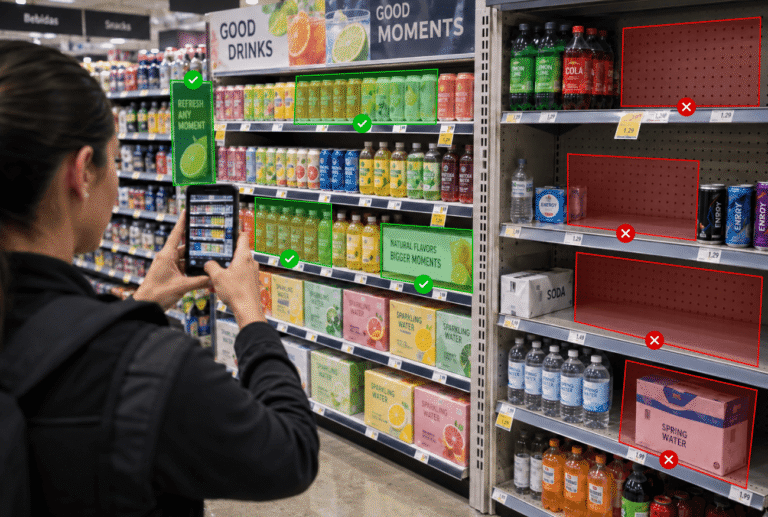
Image recognition in CPG markets fundamentally changes store audits by turning shelf photos into a structured, objective dataset. Instead of asking a field rep to manually count facings or estimate compliance (a process prone to human error and “pencil whipping”), the rep simply snaps a photo and receives real-time shelf data.
AI analyzes the image in seconds, identifying every SKU, price tag, and competitive adjacency with high precision. This shifts the source of truth from a subjective opinion (“I think the display looks good”) to verifiable evidence (“The display is present, but missing 15% of the agreed stock”).
For trade marketers and RGM leaders, this protection is twofold. First, it stops overpayment by providing irrefutable proof of execution (or lack thereof). Second, and perhaps more importantly, it allows field teams to intervene immediately. If a promotion is failing on Day 1 due to poor execution, image recognition systems flag it instantly, allowing the brand to recover that volume before the cycle ends.
Key benefits for trade protection:
- Truth: Replaces “he-said-she-said” with verifiable visual data.
- Speed: Reduces audit times from potentially hours to seconds, allowing for more store coverage.
- Actionability: Turns passive data collection into active issue resolution.
Automated verification acts as an insurance policy for your promotional investments.
What can image recognition verify on the shelf?
Modern AI solutions for CPG are trained to recognize far more than just product packaging. They analyze the entire retail environment to validate the specific KPIs that drive trade spend effectiveness.
Key verification capabilities include:
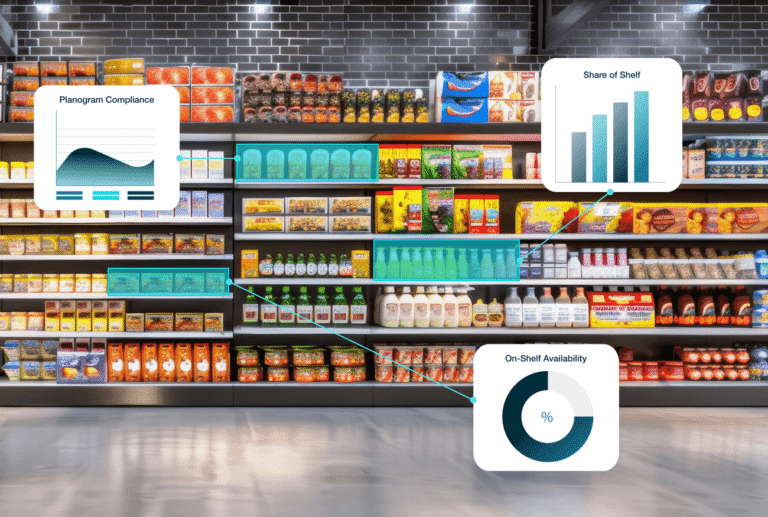
- On-Shelf Availability (OSA): Instantly detecting voids and distinguishing between “out of stock” and “voids” (tag present vs. tag missing).
- Share of Shelf (SOS): Calculating the exact percentage of total facings in a set that your brand occupies versus competitors.
- Display compliance: Verifying the presence, location, and stock levels of secondary placements like endcaps, floor displays, dump bins, and tie-ins.
- Planogram adherence: Comparing the real-time shelf image against the POG to flag misplaced items or wrong facings.
- Pricing and promo tags: Reading shelf strips to ensure the promotional price is displayed and accurate.
- Retailer disputes: capturing time-stamped, geo-tagged photos to contest deductions or prove performance.
By digitizing the shelf, brands gain granular visibility into every dollar of trade investment.
What are the most common image recognition use cases in CPG?
While the technology is powerful, its value lies in how it is applied to specific business challenges. For CPG leaders, the most effective use cases are those that directly correlate to revenue recovery and margin protection.
Primary use cases for trade execution:
- Validating paid displays: Ensuring that negotiated off-shelf displays are built on time and fully stocked during high-traffic promo windows.
- Recovering sales during promos: Catching out-of-stocks immediately during a promotion to maximize the lift when shopper intent is highest.
- Monitoring POG compliance: enforcing shelf agreements across different retail banners to prevent “space creep” by competitors.
- Price integrity checks: verifying that funded price reductions are actually passed on to the shopper at the shelf edge.
- New item launches: confirming that speed-to-shelf targets are met and that new SKUs aren’t languishing in the backroom.
- Chronic issue identification: analyzing aggregated data to spot specific retailers or regions that consistently underperform on execution.
Focusing on these high-value use cases ensures that image recognition pays for itself through recovered revenue.
A trade promotion workflow example: GoSpotCheck by FORM
To truly protect trade spend, CPG image recognition must be integrated into a closed-loop workflow. Data without action is just overhead. The goal is to move from detection to resolution while the field rep is still standing in the aisle.
Here is what that “Detect-and-Fix” timeline looks like using GoSpotCheck by FORM:
- Definition (Pre-Cycle): Trade teams configure a “Mission” in the GoSpotCheck dashboard, defining the success criteria for the upcoming promo (e.g., “Must have Endcap A, Price $4.99, Eye-Level”).
- Capture (In-Store): The field rep enters the store and opens the app. Using the guided camera interface, they snap photos of the shelf and display areas.
- Analysis (Instant): The integrated computer vision AI processes the images on the device or via the cloud, instantly identifying every SKU, pricing error, or missing display against the pre-set Mission criteria.
- Task Generation: If an issue is found (e.g., the endcap is missing or the price is wrong), the system automatically triggers a corrective task for the rep—prompting them to fix the issue immediately.
- Resolution: The rep locates stock in the backroom, builds the display, and snaps a second photo to verify the fix—closing the loop before they ever leave the store.
- Offline Capability: If the store is a “dead zone” with no signal, the GoSpotCheck app securely captures all data and photos locally, syncing them to the cloud the moment connectivity is restored.
- Review (Post-Visit): Leadership views a real-time dashboard showing compliance rates by region and retailer, allowing them to spot systemic issues and reallocate resources where they are needed most.
This workflow transforms the audit from a passive report into an active driver of sales.
How do CPG leaders use this data?
For VPs of Sales and Trade Marketing, the data generated by image recognition serves as a strategic asset for decision-making. It moves the conversation from anecdotal feedback to empirical evidence.
Strategic actions driven by IR data:
- Reallocate spend: Shift funds away from retailers with historically poor execution to partners who deliver compliance.
- Prioritize field labor: Direct field teams specifically to “hotspot” stores that are failing compliance, rather than visiting compliant stores unnecessarily.
- Resolve disputes: Use geo-tagged photo evidence to push back on unfair retailer deductions or prove performance for incentive payouts.
- Identify systemic gaps: Spot trends where specific store formats or regions consistently fail on pricing or placement.
- Monitor competitive threats: Detect when competitor products are gaining facings, encroaching on your shelf positions, or appearing in display space you’re paying for.
Leaders use these insights to fix issues before the promotion ends, saving the ROI of the current cycle.
Stop the bleeding in your trade spend
Every day your field team relies on manual audits is another day of invisible losses. The gap between what you spend on trade promotions and what is actually executed on the shelf is costing you millions—but it is a problem with a clear solution.
By digitizing the shelf with image recognition, you gain more than just data; you gain control. You get the ability to verify every dollar of investment, fix execution gaps in real-time, and hold retail partners accountable for their performance.
Don’t let another promotion cycle go by with blind spots in your execution.
Ready to see it in action? Request a demo of GoSpotCheck by FORM to see how leading CPG brands are using AI to protect their trade spend and drive perfect execution at the shelf.
FAQs
How does image recognition protect trade spend ROI?
It provides objective, real-time proof of execution. By identifying missing displays, incorrect pricing, or out-of-stocks instantly, brands can fix these issues while the promotion is live, capturing the sales lift that would otherwise be lost to poor execution.
Can it distinguish similar SKUs and packaging variants?
Yes. Advanced computer vision models are trained on your specific product library. They can differentiate between flavor variants, sizes, and even promotional packaging that looks similar to standard packaging, ensuring accurate share-of-shelf data.
How quickly can teams act on issues?
Immediate action is possible. Leading solutions process images in seconds/minutes, allowing the field rep to receive a corrective task (like “Stock the Display”) while they are still in the store, rather than waiting for a report next week.
Does GoSpotCheck by FORM work offline?
Yes. The GoSpotCheck app allows reps to capture images and complete missions in “dead zones” (like backrooms or freezers). The app stores the data locally and syncs it the moment the device reconnects to a signal.
What ROI should we expect?
ROI typically comes from three buckets: recovered revenue from fixing out-of-stocks, labor savings by reducing audit times, and reduced overpayments by verifying trade compliance.